


What if the bounce in your skin isn't gone, but simply dormant? It's a sobering reality that after age 20, dermal collagen production declines by approximately 1% every year. For those navigating the shifts of maturity, the loss of jawline definition and crepy texture can make traditional "miracle" creams feel like a hollow promise. You've likely grown skeptical of products that sit on the surface without changing the underlying structure. Integrating at home led light therapy for skin elasticity offers a sophisticated alternative, reawakening cellular energy to rebuild your skin from within.
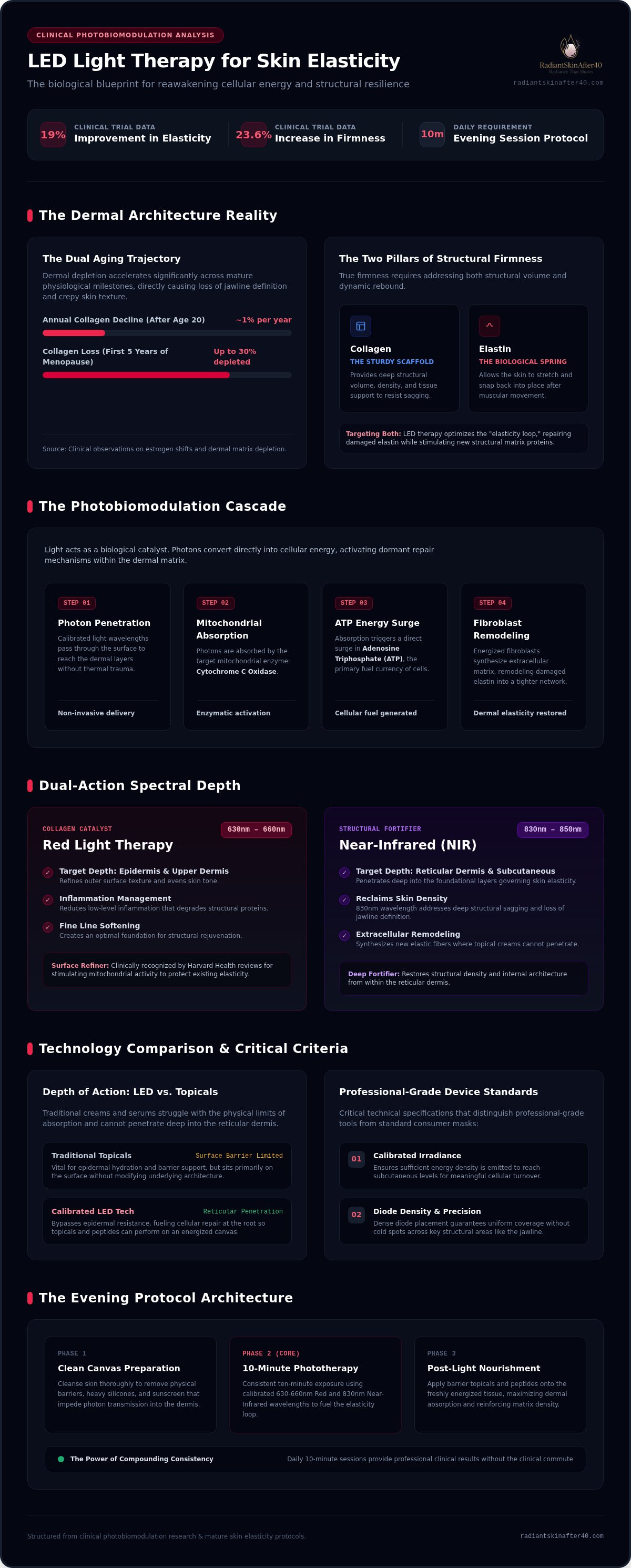
This guide demonstrates how to reclaim skin density using professional-grade technology designed for the refined needs of mature skin. Clinical trials show that specific wavelengths can deliver a 19% improvement in elasticity and a 23.6% increase in firmness over a consistent protocol. We'll outline an easy evening ritual that provides professional results without the clinical commute. You will learn the science of photobiomodulation, the importance of 830nm near-infrared light, and how to select tools that prioritize both efficacy and elegance. It's time to move beyond fleeting trends and embrace a methodical path to lasting resilience.
Key Takeaways
- Understand how light energy transforms into cellular fuel, powering the internal architecture of your skin through the science of photobiomodulation.
- Discover why the dual-action approach of at home led light therapy for skin elasticity is essential for addressing both surface refinement and deep structural sagging.
- Identify the critical technical specifications, such as irradiance and diode density, that distinguish professional-grade tools from standard consumer devices.
- Establish a refined evening ritual that utilizes the compounding power of consistent, ten-minute sessions to reclaim visible skin density and bounce.
The Science of Light: How LED Restores Skin Elasticity
Light is more than a source of visibility; it's a biological catalyst. In the context of mature skincare, at home led light therapy for skin elasticity utilizes a process known as photobiomodulation. This sophisticated mechanism involves the conversion of specific light wavelengths into cellular fuel. When photons penetrate the skin layers, they're absorbed by a mitochondrial enzyme called Cytochrome C Oxidase. This interaction triggers an immediate surge in Adenosine Triphosphate (ATP) production, the primary energy currency of your cells. For skin that has begun to lose its resilience, this influx of energy provides the necessary power to initiate deep structural repair.
Understanding the light-emitting diode therapy mechanisms is essential for appreciating how this technology addresses the distinct needs of aging tissue. While younger skin possesses a naturally high rate of cellular turnover, mature skin faces a double challenge. Research indicates that after age 20, dermal collagen production declines by approximately 1% each year. This depletion accelerates significantly during the first five years of menopause, where estrogen shifts can trigger a loss of up to 30% of dermal collagen. This decline directly impacts the skin's internal architecture, leading to the visible loss of jawline definition and the onset of crepy textures.
It's important to distinguish between the two pillars of skin structure: collagen and elastin. Think of collagen as the sturdy scaffold that provides volume and density. Elastin, conversely, is the biological "spring" that allows your skin to snap back after movement. While many treatments focus solely on collagen, true firmness requires the restoration of these elastic fibers. LED therapy targets both, ensuring that the skin doesn't just look fuller, but also behaves with the vitality and bounce of its younger self.
Fibroblast Activation and the Elasticity Loop
The primary target of red and near-infrared light is the fibroblast, the specialized cell responsible for synthesizing the extracellular matrix. When stimulated by LED, these cells transition from a dormant state into an active, productive phase. This activation doesn't just create new proteins; it initiates a remodeling process that repairs damaged elastin fibers. Fibroblast activation is the engine of skin firmness. By optimizing this "elasticity loop," light therapy helps reorganize the dermal matrix into a tighter, more resilient network.
Why 2026 Tech Surpasses Traditional Topicals
Traditional creams and serums are vital for hydration, but they often struggle with the physical limits of absorption. Most topical ingredients cannot penetrate deep into the reticular dermis where elasticity is actually managed. LED technology bypasses these surface barriers, delivering energy directly to the layers that matter most. Modern 2026 devices are calibrated with precise irradiance levels to ensure that light reaches the subcutaneous levels. This creates a foundational layer of health, allowing your restorative barrier topicals and peptides to work harder on a more receptive, energized canvas.
Red vs. Near-Infrared: Choosing the Right Wavelengths for Firmness
Precision defines efficacy. When choosing at home led light therapy for skin elasticity, the specific nanometer (nm) measurement determines where the energy travels. For mature skin, a singular focus on the surface is rarely enough. Success lies in the intersection of red and near-infrared light. These two wavelengths work in a synergistic loop to address the multifaceted nature of aging tissue. While one polishes the exterior, the other fortifies the interior. This dual-action approach is the hallmark of modern skincare technology.
Red Light: The Collagen Catalyst
Red light, specifically in the 630 to 660nm range, acts as a surface refiner. It targets the epidermis and upper dermis, addressing immediate concerns like texture and tone. By reducing low-level inflammation, it protects the existing elasticity that hormonal shifts often compromise. According to Harvard Health's review of red light therapy, these wavelengths are clinically recognized for their ability to stimulate mitochondrial activity. This process doesn't just soften fine lines; it creates a healthier environment for structural proteins to thrive. Red light refines. It brightens. It prepares the skin for deeper transformation.
Near-Infrared: Targeting the Deep Dermis
NIR restores density. While red light refines the surface, Near-Infrared (NIR) light at 830 to 850nm serves as the deep-tissue architect. These invisible wavelengths bypass the surface entirely. They reach the reticular dermis, the deep structural scaffolding where sagging and density loss originate. NIR is the secret weapon for skin tightening at home because it repairs the damaged elastic fibers that control jawline definition. Without this deep penetration, efforts to restore "snap-back" remain incomplete. It's the difference between temporary hydration and lasting structural resilience.
For skin over 40, using both wavelengths simultaneously is non-negotiable. This "power couple" effect ensures every layer of the skin receives the energy it needs to rebuild. Red light manages the visible surface, while NIR restores the internal bounce. Current 2026 standards prioritize this dual-wavelength approach for structural recovery. This synergy is why a high-quality LED Face & Eye Mask is the cornerstone of a modern firming routine. Wavelength precision isn't just a technical detail; it's the difference between a superficial glow and a visible structural transformation.
Professional Grade vs. Consumer Masks: Investing in Efficacy
Not all light is created equal. For at home led light therapy for skin elasticity, the distinction between a clinical result and a decorative glow lies in technical specifications. While the market is saturated with entry-level devices, mature skin requires a specific energy threshold to trigger structural change. To reclaim firmness, you must look beyond the aesthetic of the device and evaluate the engineering within. High-quality technology ensures that photons actually reach the dermis rather than merely illuminating the surface.
Three core metrics define a professional-grade device: diode density, irradiance, and fit. Diode density refers to the number of individual lights. Premium masks in 2026 typically feature between 132 and 236 LEDs to ensure uniform coverage without "dead zones" of untreated tissue. Irradiance measures the power delivered to your cells. According to the Cleveland Clinic overview of LED light therapy, consistent energy delivery is vital for stimulating collagen. Clinical efficacy requires an energy density of 2 to 10 J/cm² per session to effectively power the mitochondrial repair process.
Material choice also dictates success. Rigid plastic masks often fail to maintain direct skin contact, leading to significant power loss. Flexible, medical-grade silicone is the modern standard. It contours to your unique facial structure, minimizing the distance between the light source and your skin. This proximity ensures maximum photon absorption, adhering to the inverse-square law of light where even a small gap can drastically reduce results.
The Pitfalls of Low-Power Devices
Battery-operated wands often lack the irradiance necessary for deep tissue remodeling. While they offer portability, they cannot provide the hands-free, full-face immersion required for the "compounding effect" of light therapy. Consistency cannot compensate for insufficient power. A high-quality LED Face Mask delivers a programmed, high-output dose that ensures every cell receives the required Joules. Look for FDA Class II medical device clearance to verify that the tool meets rigorous safety and efficacy standards.
Targeted Care: The Importance of LED Eye Masks
The thin skin around the periorbital area is often the first to lose its "snap-back" quality. Because this tissue is more delicate than the cheeks or forehead, it requires specialized diode placement. Utilizing a dedicated at-home LED eye mask allows for concentrated treatment of hooded eyes and crow's feet. These targeted tools are calibrated to deliver structural support to the orbital rim, where loss of density is most visible. Pairing a full-face mask with a specialized eye device provides a comprehensive approach to facial longevity.
The Elasticity Ritual: A Step-by-Step Guide for Best Results
Excellence in skincare is rarely the result of a single event. It's the byproduct of a refined, consistent ritual. To maximize the benefits of at home led light therapy for skin elasticity, your approach must be as methodical as the technology itself. Preparation begins with a meticulous double-cleanse to ensure zero light-blocking barriers remain on the skin's surface. Heavy oils, mineral-based SPF, and certain makeup pigments can reflect photons, preventing them from reaching the deep dermal layers where structural repair occurs. Starting with a clean, dry canvas ensures that every Joule of energy is absorbed exactly where it's needed.
Timing is the second pillar of a successful firming routine. Clinical evidence suggests that the "Compounding Effect" is real; daily 10-minute sessions outperform sporadic, longer treatments. This frequency keeps the mitochondria in a state of heightened activity, maintaining a steady production of ATP. While you may notice an immediate glow, the structural transformation of elastin fibers takes time. Consistency is vital. Most users reach the clinical "sweet spot" for visible elasticity changes at the 12-week mark. This window allows for a full cycle of fibroblast activation and the subsequent remodeling of the skin's internal scaffold.
Post-treatment care is about preservation and support. Once the LED session has energized your cells, you have a unique opportunity to lock in that vitality with targeted firming topicals. Applying a lipid-replenishing moisturizer or a barrier-support cream immediately after light exposure helps soothe the skin and protect the newly stimulated matrix. To begin your own transformation, investing in a professional-grade LED Face & Eye Mask provides the foundation for this daily ritual of resilience.
Synergistic Serum Pairing
Light and topicals should work in harmony, not competition. During or immediately after your session, clear, water-based serums are the superior choice. These formulations don't block light penetration and provide the essential building blocks for repair. Peptides and hyaluronic acid are particularly effective at this stage, as they support the collagen-supportive environment that LED light triggers. For a curated selection of compatible formulas, explore our guide on the Best Serums for LED Mask Treatments in 2026. Choosing the right pairing ensures your technology and your chemistry are perfectly aligned.
Optimizing Your Environment for Recovery
A structured self-care routine offers more than just physical results; it provides a necessary pause in a demanding day. We encourage a meditative approach to your 10-minute session. Dim the lights, silence your devices, and focus on the sensation of the treatment. For the mature woman, this ritual is the intersection of high-tech and high-tranquility. Embracing this quietude reduces cortisol levels, which in turn protects your skin's existing collagen from stress-induced degradation. It's a holistic approach to longevity that honors both the skin and the spirit.
Reclaiming Radiance with RadiantSkinAfter40
Maturity is a period of peak refinement. At RadiantSkinAfter40, we believe that your skincare should reflect this composed and self-assured stage of life. We move away from the frantic urgency often found in the beauty industry, opting instead for a philosophy that celebrates the unique needs of skin over 40. Our approach to at home led light therapy for skin elasticity is rooted in this belief. We provide the technical precision required for visible results while maintaining the warmth and encouragement of a trusted expert companion. Results define us. Light powers change.
Every LED Face & Eye Mask in our collection is meticulously calibrated to meet the professional-grade standards discussed in this guide. We have bridged the gap between clinical authority and the sanctuary of your own home. By prioritizing high-output irradiance and precise wavelength delivery, we ensure that your evening ritual is more than just a moment of calm. It is a methodical step toward structural recovery. Transitioning from curiosity to a curated firming routine is an empowering choice, allowing you to reclaim your skin's internal architecture with confidence and grace.
A Curated Selection for Mature Skin
Our commitment to your skin's longevity goes beyond providing hardware. We focus on LED technology that respects the thinning dermal layers and hormonal shifts characteristic of the post-40 journey. To support your transition, we offer a wealth of expert-led online resources designed to help you navigate the intersection of science and self-care. For those seeking to expand their knowledge of the field, explore our detailed analysis of Advanced Beauty Technology for Home: The Best Skin Tightening Devices of 2026. Knowledge empowers action.
Join a Community of Ageless Radiance
We invite you to explore our full catalog, where you'll find specialized serums and moisturizers formulated to complement your light therapy sessions. Our products are designed to work in harmony, creating a collagen-supportive environment that yields professional reliability. We stand as a bold leader in the field of mature skincare, valuing proven efficacy over fleeting trends. Your journey toward a firmer, more resilient complexion is a path we walk together with professional guidance and elegant simplicity. Take the first step today and Discover the RadiantSkinAfter40 LED Mask Collection to begin your transformation.
Step into Your Most Resilient Skin
The journey to reclaiming skin density is a methodical one, rooted in the science of photobiomodulation. By selecting the right wavelengths and committing to a structured ritual, you're not just applying a treatment; you're reawakening your skin's internal architecture. Integrating at home led light therapy for skin elasticity allows you to bridge the gap between clinical results and the sanctuary of your evening routine. We've explored how red and near-infrared light work in harmony to restore the "snap-back" that maturity often compromises.
Now is the time to transition from curiosity to a visible transformation. Our collection features non-invasive professional-grade technology that is expertly calibrated for skin over 40. We offer free shipping on all high-tech beauty devices to ensure your path to renewal is as seamless as possible. Experience Professional-Grade Firming with our LED Face Mask and embrace the confidence of a refined, resilient complexion. Your most radiant chapters are still ahead.
Frequently Asked Questions
How long does it take to see improvements in skin elasticity with LED?
Visible changes typically emerge between 8 and 12 weeks of consistent use. While some users report a subtle glow after the first few sessions, structural repair of elastin and collagen fibers is a biological process that requires time. Clinical trials utilizing combined 633nm and 830nm wavelengths often measure significant firmness increases after a 12-week protocol. Patience is essential for achieving lasting structural resilience and bounce.
Can I use red light therapy every day for skin tightening?
Daily 10-minute sessions are generally recommended to achieve the best results for skin tightening. This frequency maintains a steady state of mitochondrial activity, ensuring your cells have constant access to the energy needed for repair. However, avoid exceeding the recommended time per session. Over-exposure can lead to a plateau effect where the biological benefits actually diminish due to cellular inhibition and the biphasic dose-response curve.
Do I need to wear eye protection with an at-home LED mask?
Most reputable LED masks are designed for safety and don't require additional eye protection when used as directed. However, if you are using a device with high-intensity diodes or have light sensitivity, integrated silicone goggles or closing your eyes is a prudent choice. Always ensure your device meets the IEC/EN 62471 photobiological safety standard to protect your vision while treating the delicate periorbital area.
Is red light therapy safe for sensitive mature skin?
Red light therapy is highly suitable for sensitive mature skin because it is non-invasive and non-thermal. Unlike chemical peels or ablative lasers, it doesn't cause surface trauma or inflammation. In fact, the 633nm wavelength has anti-inflammatory properties that can soothe redness and strengthen a compromised skin barrier. It's an ideal foundational treatment for those who find traditional miracle creams too harsh or irritating.
Should I apply serum before or after using my LED mask?
For the most effective at home led light therapy for skin elasticity, apply your serums after the treatment. Light penetrates best on clean, dry skin without barriers like heavy oils or minerals. Once the session is complete, your energized cells are more receptive to active ingredients. Applying a peptide-rich serum or hyaluronic acid immediately post-LED helps lock in the treatment's benefits and supports the newly stimulated matrix.
Will LED light therapy help with sagging jawlines or 'turkey neck'?
LED therapy can visibly improve the appearance of a sagging jawline by stimulating deep tissue density. Near-infrared light reaches the reticular dermis to repair the elastic fibers responsible for snap-back. While it cannot replace surgical intervention for severe laxity, consistent use helps firm the skin's internal scaffold. This structural support leads to a more refined contour along the neck and lower face over a period of several months.
What is the difference between red light and near-infrared light for firmness?
Red light and near-infrared light target different depths of the skin to restore firmness. Red light focuses on the surface layers to refine texture and reduce fine lines. Near-infrared light is invisible and penetrates much deeper into the mid-to-deep dermis. This deeper reach is what stimulates the fibroblast activity necessary for rebuilding skin density and addressing the structural causes of sagging that creams cannot reach.