


The most powerful-looking LED mask may not be the right one for dark spots. For mature skin, published wavelengths, irradiance, fit, and clear instructions are more useful than a long list of settings. A led mask for dark spots over 50 should be considered as one part of a careful routine, not a guaranteed way to erase discoloration.
If creams haven’t made a visible difference, it’s understandable to wonder whether at-home light therapy might suit your routine. It’s also reasonable to be cautious if your skin is easily unsettled. LED masks use specific wavelengths, but devices differ in what they emit and how much light reaches the skin. That makes the product details worth checking before you buy.
This guide explains what wavelengths and irradiance can tell you, how to compare fit and comfort, and why the cause of a dark spot matters. It also covers realistic expectations and ways to keep your skincare routine simple. With clear information, you can decide whether an at-home LED mask belongs in your skin-care routine.
Key Takeaways
- Age spots and melasma can look similar but have different causes, so identifying the type of discoloration matters.
- Wavelength and irradiance are useful details to compare when choosing a led mask for dark spots over 50.
- Fit, materials, eye-safety guidance, and ease of use matter alongside a device’s technical specifications.
- Ingredients such as vitamin C, niacinamide, and peptides may complement a consistent skincare routine, but don’t guarantee that LED will fade discoloration.
- An LED Face & Eye Mask can bring light-based skincare into a home routine when used according to its instructions.
Addressing the Root of Hyperpigmentation After 50
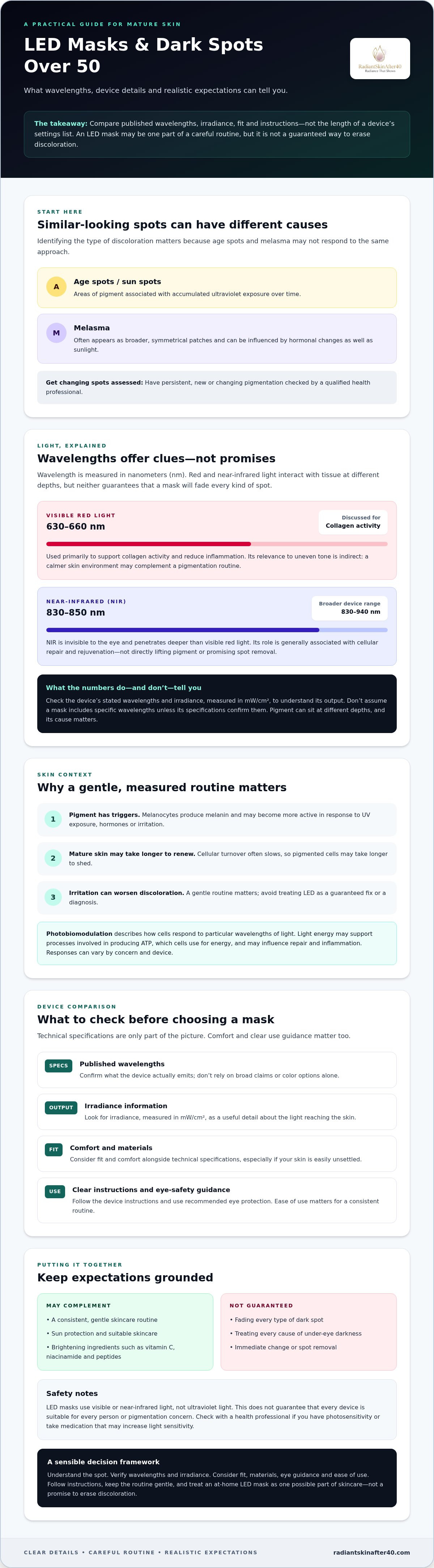
Dark spots can have different causes, so a useful routine starts with understanding what you’re seeing. Age spots, also called sun spots, are areas of pigment associated with accumulated ultraviolet exposure over time. Melasma often appears as broader, symmetrical patches and can be influenced by hormonal changes as well as sunlight. The two can look similar, but they may not respond to the same approach. Have persistent, new, or changing pigmentation assessed by a qualified health professional.
In both cases, melanocytes, the cells that produce melanin, may become more active in response to triggers such as UV exposure, hormones, or irritation. The idea that these cells become “stuck” is a helpful shorthand, not a diagnosis. Pigment production can remain elevated after an original trigger has passed. That’s one reason a led mask for dark spots over 50 is best treated as one part of a measured routine, not as a guaranteed way to remove discoloration.
The Biological Shift: Why Spots Persist
As skin matures, cellular turnover often slows, so pigmented cells may take longer to shed. Ongoing low-grade inflammatory signals, sometimes called “inflammaging,” may also affect how skin responds to stress and contribute to uneven-looking tone. A gentle routine matters because irritation can itself worsen discoloration. Read more about ways to improve skin texture after 40.
Photobiomodulation: Light as a Messenger
Photobiomodulation describes how cells respond to particular wavelengths of light. In simple terms, cellular structures absorb light energy, which may support processes involved in producing ATP, the molecule cells use for energy. This signaling may influence repair and inflammation, but it doesn’t mean every pigment concern will respond in the same way. The overview of Light-emitting diode (LED) therapy provides background on the approach and its uses.
LED masks use visible or near-infrared light, not ultraviolet light. That means LED does not rely on UV exposure, but it doesn’t guarantee that every device is suitable for every person or pigmentation concern. Follow the device instructions and use recommended eye protection. Check with a health professional if you have photosensitivity or take medication that may increase light sensitivity. For mature skin, prioritize comfort, consistent use as directed, and realistic expectations.
The Science of Light: Wavelengths and Dark Spots
Light isn’t one-size-fits-all. Its effects depend on wavelength, measured in nanometers (nm), and on how much light reaches the skin. Red and near-infrared (NIR) wavelengths are often discussed in relation to inflammation and skin repair. Those effects may complement a pigmentation routine, but they don’t guarantee that a mask will fade every type of spot. When comparing a led mask for dark spots over 50, check what the device actually emits rather than relying on broad claims.
Red light around 630 to 660 nm is used primarily to support collagen activity and reduce inflammation. NIR around 830 to 850 nm is part of the broader 830 to 940 nm range used in skin-rejuvenation devices, and penetrates deeper than visible red light. The wavelengths therefore interact with tissue at different depths. That distinction doesn’t mean NIR can selectively reach or remove a particular dark spot. Pigment can sit at different depths, and the cause of the discoloration matters too.
Red Light: A Potential Complement to a Pigmentation Routine
Red light’s relevance to uneven tone is indirect. By supporting a calmer skin environment, it may help address inflammation that can contribute to pigment changes. Its collagen-related effects may also support a firmer-looking complexion. An at-home LED eye mask is designed for targeted use around the orbital area, but don’t assume it will treat every cause of under-eye darkness.
Near-Infrared: Deeper Support
NIR is invisible to the eye, unlike red light, and can reach deeper tissue. Its role is generally associated with cellular repair and rejuvenation, rather than directly lifting pigment to the surface. Claims that it “flushes out” pigment or waste oversimplify how skin works. Its potential role is to complement red light and support deeper repair processes, not to promise spot removal.
Precision matters more than a device’s color options or bulb count. Check the stated wavelengths and look for irradiance information, measured in mW/cm², to understand the device’s output. Don’t assume a mask includes specific wavelengths unless its specifications confirm them. Use it as directed alongside sun protection and suitable skincare, rather than expecting immediate change. If you’re comparing at-home options, explore the brand’s LED face and eye masks.
Choosing a LED Mask for Dark Spots Over 50
A high LED count can look impressive, but it doesn’t show how much light reaches the skin or whether the mask sits evenly against your face. When comparing a led mask for dark spots over 50, look at the full picture: published output, fit, comfort, eye-protection guidance, and ease of regular use. These details are more useful than a crowded specification sheet.
Irradiance and Energy Delivery
Irradiance measures optical power reaching a specific surface area, usually expressed in milliwatts per square centimeter (mW/cm²). It helps you understand the light delivered at the treatment surface, while LED count alone does not. Look for a clearly stated irradiance value and instructions that explain the recommended session length. If output information is unclear, don’t assume that adding treatment time is appropriate. Follow the device directions rather than extending sessions to compensate for unknown power.
Design for Mature Facial Contours
Face shapes vary, and a rigid shell may leave areas such as the jawline or around the mouth farther from the LEDs. A flexible design may sit more closely across facial contours. Check material descriptions rather than assuming a mask uses medical-grade silicone. Comfort matters too: choose a mask that feels secure without pressure and is practical to wear for the full instructed session. Check that eye-protection guidance is clear, especially if your eyes are sensitive.
Before comparing devices, consider these practical questions:
- Coverage: Does the mask sit evenly across the forehead, cheeks, jaw, and areas you want to address?
- Materials: Are the materials and care instructions clearly described? Don’t assume silicone is medical grade unless the manufacturer confirms it.
- Wearability: Does the mask feel comfortable for the full instructed session?
- Routine fit: Would a wireless design make use simpler, or would you prefer a corded device that stays in one place?
Ease of use matters because a comfortable, uncomplicated design can make it more realistic to follow a regular routine. An elegant appearance can be a plus, but it shouldn’t replace transparent specifications and clear instructions. Choose a mask for its practical fit and verified details, not its LED count alone.
Pairing LED with Topical Brightening Serums
Pairing skincare with LED therapy calls for thoughtful timing. “Pre-treating” shouldn’t mean layering products under a mask to increase light absorption. A serum or cream may change how light reaches the skin, and there’s no established need to apply brightening ingredients beforehand for LED to work. Start with clean, dry skin unless your device instructions specify otherwise. Save most leave-on products for after the session.
Choosing the Right Serum for Your Session
After LED use, consider a lightweight, water-based serum rather than a heavy cream that could leave a film during treatment. Vitamin C is used in routines aimed at a brighter-looking complexion. Niacinamide can support the skin barrier and a more even appearance, while peptides are included in some routines for mature skin. No ingredient guarantees that LED will fade discoloration. For product-pairing ideas, explore this guide to serums for LED mask treatments.
Niacinamide may suit a routine for dull or uneven-looking skin, and its barrier-supporting role can be useful when skin feels more vulnerable. Introduce new ingredients gradually and follow product directions. Avoid applying retinoids immediately before a light session, since photosensitizing ingredients may increase sensitivity. If you’re unsure how a product interacts with your device, check the manufacturer’s guidance or ask a qualified health professional.
Post-Treatment Rituals
There’s no need to chase a narrow “window of opportunity” for absorption. The information here doesn’t establish that LED creates a special period when serums penetrate better. Instead, use the post-session step to replenish and comfort skin with familiar products. A moisturizer can help reduce moisture loss and support the skin barrier; it doesn’t “lock in” LED repair signals.
A simple sequence keeps the ritual clear:
- Cleanse: Remove makeup, sunscreen, and residue, then dry the skin.
- Treat with light: Use the mask as directed, with no heavy product underneath unless its instructions allow it.
- Apply serum: Choose a well-tolerated formula suited to your skin goals.
- Moisturize: Finish with a moisturizer that supports comfort and hydration.
Consistency matters more than adding extra layers. If you’re refining a broader routine, an anti-aging body care routine can complement facial care without relying on identical products or claims. Explore serums and moisturizers for mature skin to build a routine around your LED sessions.
Adding the RadiantSkinAfter40 LED Mask to Your Routine
A considered skincare ritual should support your skin as it is, not promise to turn back time. RadiantSkinAfter40 focuses on advanced beauty technology for mature skin, including LED face and eye masks designed for skin after 40. Its LED Face & Eye Mask offers a way to bring light-based care into a home routine.
Professional-Grade Care at Home
A hands-free mask can make a session easier to fit into a quiet moment at home. Before choosing any device, review its wavelengths, irradiance, fit, eye-protection guidance, and instructions. RadiantSkinAfter40 offers LED masks for home use. Check the product information for specific output details rather than assuming which wavelengths or irradiance a device provides.
Think of a mask as one element in a broader routine, not a standalone answer to every dark spot. Results from at-home LED use aren’t immediate, and visible changes may take consistent use over several weeks or months. The aim is gradual support for skin appearance and radiance, not a guaranteed transformation. Daily sun protection and well-tolerated skincare remain important parts of caring for uneven tone.
A Considered 12-Week Routine
Use the first 12 weeks as a structured period to build consistency and observe your skin, not as a promised deadline for results. Let the device’s directions determine session length and frequency. Don’t increase use in pursuit of faster changes.
- Before you begin: Read the instructions, check eye-safety guidance, and take a clear baseline photo in consistent lighting.
- Weeks 1–4: Follow the recommended schedule and keep the rest of your skincare routine simple and comfortable.
- Weeks 5–8: Continue as directed. Note any changes in skin comfort, tone, or radiance without expecting every spot to respond alike.
- Weeks 9–12: Compare photos taken in similar lighting. If irritation develops, stop use and seek appropriate guidance.
Self-care can be practical as well as considered. For women over 50, a led mask for dark spots over 50 is best viewed as a long-term skincare tool, chosen for clear specifications and realistic expectations. Explore RadiantSkinAfter40’s LED face and eye mask as you consider whether light-based care fits your routine.
Choose a More Considered Path to Radiance
Choosing a led mask for dark spots over 50 starts with informed expectations. Wavelength and irradiance deserve more attention than LED count alone, while comfortable fit and clear instructions help make a device practical for regular use. Pigmentation has different causes, so no mask can promise the same outcome for every complexion or concern.
Build your approach around consistency and comfort. Use the device as directed and keep your skincare routine simple, with supportive hydration and daily sun protection. Think of progress as gradual, and seek professional guidance if a spot changes or you’re unsure what is causing the discoloration.
RadiantSkinAfter40 focuses on advanced beauty technology for mature skin, offering LED face and eye masks for home use. The LED Face & Eye Mask can be a considered addition to a non-invasive routine designed around the needs of skin after 40. Explore the RadiantSkinAfter40 LED Face & Eye Mask to see whether it suits your skincare routine.
Frequently Asked Questions
Is an LED mask safe for skin over 50 with sun damage?
LED masks are generally considered safe for short-term use when used according to the device instructions, but sun-damaged skin still needs careful attention. LED uses non-UV light, unlike the ultraviolet exposure that contributes to sun damage. Pigmentation can have different causes, and light therapy may not suit every concern. Have a new, changing, or unusual spot assessed by a qualified health professional before treating it cosmetically.
How often should I use an LED mask to see results on dark spots?
Follow the schedule provided with your specific mask, since recommended frequency and session length vary by device. There isn’t one universal routine for a led mask for dark spots over 50. Visible changes, if they occur, are gradual and may take several weeks or months of consistent use. More frequent or longer sessions aren’t necessarily more effective, so don’t exceed the manufacturer’s directions.
Can I use an LED mask if I have sensitive skin or rosacea?
Possibly, but sensitivity and rosacea can make individual responses less predictable. LED isn’t ultraviolet light or an exfoliating treatment, yet that doesn’t mean every device or wavelength will feel comfortable for everyone. Review the mask’s instructions and consult a qualified health professional before use if you have rosacea, photosensitivity, or take medication that may increase light sensitivity. Stop using the device if you experience discomfort or irritation.
Do I need to wear eye protection with a professional LED mask?
Follow the eye-safety instructions supplied with your particular mask. Some devices include eye protection or are designed to shield the eyes, while others may require separate protection. Don’t assume that closing your eyes is enough or that every wavelength is harmless to look at. If the guidance is unclear, check with the manufacturer before using the device, especially if you have an eye condition or light sensitivity.
What is the difference between red light and blue light for aging skin?
Red light, commonly used around 630 to 660 nm, is associated with collagen support and calming inflammation. Blue light, often around 415 nm, is used primarily for acne because it can target acne-related bacteria. Blue light isn’t generally the first choice for age-related dark spots, and research suggests it may stimulate pigmentation in some darker skin tones. Choose based on your skin concern and the device’s stated wavelengths.
Can I use Vitamin C serum with my LED mask treatment?
Yes, vitamin C can be part of an LED skincare routine if your skin tolerates it, but apply it after the session rather than layering it under the mask unless the device instructions say otherwise. Start with clean, dry skin so product residue doesn’t interfere with light reaching the skin. After treatment, apply your serum and moisturizer as directed, and introduce new products gradually to watch for irritation.
Will an LED mask help with deep wrinkles as well as dark spots?
Some red and near-infrared devices are intended to support collagen-related changes and improve the appearance of skin texture, but results vary. That doesn’t mean a mask will erase deep wrinkles or treat every kind of pigmentation. LED’s role in dark spots depends partly on their cause, and melasma can be more complex. Choose a device for its verified specifications, and keep expectations realistic.
How long do the results from an at-home LED mask last?
There isn’t a set duration for results from at-home LED use. Outcomes depend on the device, consistency, skin concern, and other factors, including ongoing sun exposure. LED shouldn’t be considered a permanent fix for pigmentation or signs of aging. Follow the device’s maintenance guidance, protect your skin from UV exposure, and remember that a changing or persistent dark spot may need professional assessment rather than continued home treatment.