


Morning may be the familiar choice, but it isn’t the only sensible one. A vitamin c serum for night can fit into an evening routine, even if you’ve heard that this antioxidant belongs exclusively in the morning. The right formula and your skin’s comfort matter more than the hour you apply it. Nighttime use doesn’t automatically make vitamin C more effective, and using it in the evening doesn’t replace daytime sun protection. Consistency and tolerance are better guides than the clock.
This guide explains how to decide whether evening use suits your routine, what to check when comparing formulas, and how to introduce a serum without overloading your skin. You’ll learn about L-ascorbic acid and vitamin C derivatives, how to layer serum with moisturizer and other active ingredients, and when to adjust your routine. The goal is a clear, manageable sequence, not a more complicated ritual.
Key Takeaways
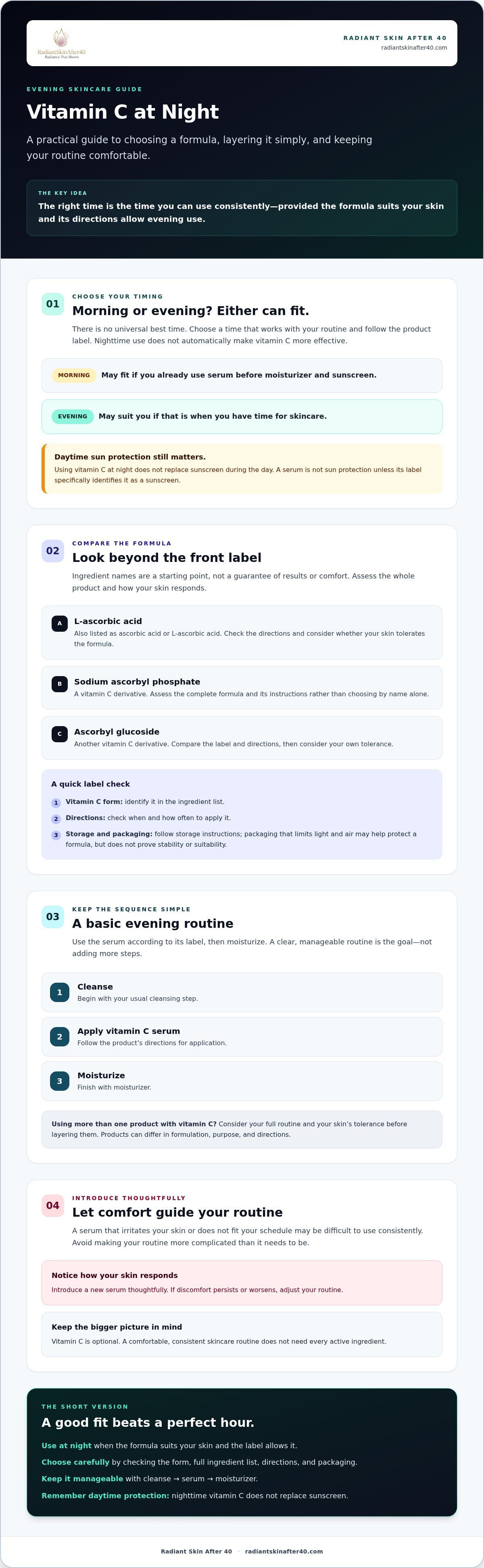
- A vitamin c serum for night can suit your routine if its formula agrees with your skin and its directions allow evening use. Nighttime alone doesn’t promise stronger results.
- Compare the vitamin C form, full ingredient list, directions, and packaging rather than choosing by the front label alone.
- Start with a simple evening sequence: cleanse, apply serum according to its label, then moisturize.
- Introduce a new serum thoughtfully and respond to discomfort that persists or worsens.
- Vitamin C is optional. A comfortable, consistent routine doesn’t need every active ingredient.
Vitamin C Serum for Night: Does Evening Use Make Sense?
Yes. Many people can use vitamin C in the evening if the formula suits their skin and the product directions allow nighttime application. Choosing a vitamin c serum for night is a matter of routine and comfort, not a shortcut to stronger or faster results. A serum that irritates your skin or doesn’t fit your schedule may be difficult to use consistently, whatever time you apply it.
Does vitamin C work better at night or in the morning?
There’s no universal time that works best for everyone. Morning may be convenient if you already apply a serum before moisturizer and sunscreen. Evening may suit you better if that’s when you have time for skincare. Choose a time you can maintain and follow the product label. Don’t assume that overnight skin repair makes vitamin C uniquely effective at night.
Keep sun protection in your daytime routine. Using vitamin C at night doesn’t replace sunscreen during the day. A serum isn’t sun protection unless its label specifically identifies it as a sunscreen.
What can vitamin C contribute to a skincare routine?
A topical vitamin C serum is a leave-on skincare product formulated with a vitamin C ingredient, commonly used to support a brighter, more even-looking appearance. Its effect depends on the formula and how well it suits your skin. It isn’t a guaranteed result or a medical treatment.
Vitamin C is also an essential nutrient involved in the repair of tissue. That describes its role in the body, not a promise that applying a serum will reproduce the effects of dietary vitamin C or treat a skin condition.
Serums aren’t the only skincare products that may contain vitamin C. A moisturizer or another product may include a vitamin C ingredient, but products differ in formulation, purpose, and directions. Read the labels instead of assuming they all work in the same way. If you already use more than one, consider your full routine and your skin’s tolerance before layering them.
To decide whether evening use makes sense, check that the product is intended for your face and that its directions allow nighttime application. Then choose morning or night based on the label and the time you can use it consistently. The clock matters less than a formula your skin tolerates and daytime sun protection you remember to apply.
Vitamin C Serum Forms and Formula Details Worth Understanding
The ingredient name is a starting point, not a complete buying guide. L-ascorbic acid is one commonly used form of vitamin C. Sodium ascorbyl phosphate and ascorbyl glucoside are alternative forms known as derivatives. These ingredients don’t guarantee the same results. The full formula, directions, and your skin’s response all matter when deciding whether a vitamin c serum for night is right for you.
How do L-ascorbic acid and vitamin C derivatives differ?
L-ascorbic acid is vitamin C in its direct form. Derivatives are related ingredients used in skincare formulations, but their characteristics and supporting evidence can differ. A form that sounds more advanced or gentle isn’t automatically the best fit for everyone. Consider the product as a whole, and look for clear directions and relevant evidence rather than assuming the ingredient name predicts how your skin will respond.
| Form | Label name | General selection consideration |
|---|---|---|
| L-ascorbic acid | Ascorbic acid or L-ascorbic acid | Check the product’s directions and consider whether your skin tolerates the formula. |
| Derivative | Sodium ascorbyl phosphate | Assess the complete formula and its instructions, rather than choosing by name alone. |
| Derivative | Ascorbyl glucoside | Compare the label and directions, then consider your own tolerance. |
For a broader overview of potential uses and considerations, Harvard Health Publishing discusses topical vitamin C. General information can help frame questions, but it can’t establish how a particular serum will perform.
Which label and packaging details should you check?
Read the ingredient list to identify the form, then find the maker’s directions, including when and how often to apply the product. Check storage instructions as well. Packaging that limits exposure to light and air may help protect a formula, but packaging alone doesn’t prove how stable or suitable a serum is.
A serum’s suitability depends on its full formula, packaging, directions, and your skin’s tolerance, not just the vitamin C ingredient named on the front label. When comparing products, note whether the directions fit your evening routine and whether you can introduce the serum without adding several new active ingredients at once.
RadiantSkinAfter40 offers skincare serums and moisturizers as product categories. Check individual product details before assuming a particular vitamin C formula is available. You can explore skincare serums and verify the ingredients and directions before choosing.
How to Layer Vitamin C Serum in an Evening Skincare Routine
A calm routine is easier to follow and assess. For a vitamin c serum for night, a simple starting order is cleanse, apply the serum according to its directions, then moisturize. If the product label gives a different sequence or specific application instructions, follow those instead. Formulas vary, so a general routine shouldn’t override the maker’s guidance.
Where does vitamin C serum go after cleansing?
Begin with clean skin. Apply the serum as directed, then use moisturizer to finish the basic routine. You don’t need to add a toner or extra treatment to make this sequence work. If you use a prescription treatment, ask the prescriber who manages it how to position it in your routine. Don’t change its instructions based on a general skincare order.
Keep the first version simple. If you add several unfamiliar active ingredients at once, it can be difficult to tell which product is causing irritation. Introduce products one at a time and observe your skin before changing another part of the routine.
Can vitamin C be used with other evening ingredients?
There isn’t one layering rule for every formula or skin type. Retinoids, exfoliating acids, and other active ingredients may be part of a skincare routine, but combining them with vitamin C can make it harder to assess how your skin responds. Check each product’s directions, introduce one active at a time, and avoid starting multiple new treatments on the same evening.
If you use prescription products or have a skin condition, ask your prescriber or another qualified healthcare professional before changing how you combine treatments. Persistent discomfort is a reason to pause the new product and seek appropriate guidance, not to layer on more products to counteract it.
If you use an LED device in the evening, don’t assume every serum can be used with it. Follow the device and skincare product instructions for application order and use. The article on serums for LED mask treatments offers related guidance on considering skincare alongside device routines. A review in the National Center for Biotechnology Information also discusses the role of powerful antioxidants in the skin, providing scientific context without replacing product-specific directions.
Let comfort guide the pace. A short routine that you follow consistently is more useful than a crowded lineup whose effects are difficult to separate.
How to Start Vitamin C at Night and Respond to Irritation
A considered introduction gives you a clearer sense of how a new formula feels on your skin. For a vitamin c serum for night, follow the product’s own instructions rather than applying a schedule meant for a different serum. Formulas vary, and there isn’t one starting frequency that suits them all. Keep the rest of your routine familiar while you assess the new product.
How can a beginner introduce a new serum carefully?
Start by reading the label, including any patch-testing directions. Apply the product to the recommended small area and observe your skin as instructed before using it more widely. A patch test can offer useful information, but it can’t guarantee that irritation won’t occur later.
If the label permits gradual introduction, begin at a manageable frequency based on its guidance and your personal tolerance. Avoid adding another unfamiliar active ingredient at the same time. That leaves fewer new variables to consider if your skin becomes uncomfortable. Don’t increase use simply because you haven’t noticed a visible change right away. Follow the product directions and give yourself time to assess comfort.
What if vitamin C makes skin feel uncomfortable?
A brief, mild sensation and ongoing discomfort aren’t the same. Some people may notice a temporary mild sensation, while persistent burning, swelling, or substantial redness deserves more caution. Don’t assume a reaction is harmless or try to diagnose its cause from appearance alone.
Follow the product label, monitor how your skin responds, and stop use if significant irritation occurs. If symptoms persist, worsen, or concern you, seek advice from a qualified healthcare professional. If you experience swelling or a severe reaction, seek urgent medical care. Don’t keep applying the serum to see whether your skin eventually adjusts.
Give your skin room to settle before introducing another new product. Keeping your routine simple can help you observe changes, but no sequence or schedule can promise to prevent irritation. If you use prescription treatments or have a skin condition, ask the professional responsible for your care before adding a new active serum.
Choose products by checking their ingredient information and directions, not by assuming every serum suits every skin type. RadiantSkinAfter40 offers serums as a product category, but a specific vitamin C formula isn’t confirmed. Verify product details before making a choice. Explore skincare serums and review the available information carefully.
Build a Consistent Night Routine for Mature Skin
A good evening routine doesn’t need to be elaborate. Your skin’s feel, preferences, and product tolerance can shift over time. Rather than chasing a fixed number of steps, build around comfort, clear directions, and products you can use consistently. Vitamin C is optional. A thoughtful routine doesn’t need every active ingredient, and leaving one out can be the right choice for your skin.
What does a balanced evening routine look like?
Keep the foundation simple, then add only what has a clear place in your routine:
- Cleanse to remove the day’s buildup, following the cleanser’s directions.
- Use a chosen treatment, such as a vitamin C serum, only as its label directs and if it suits your skin.
- Moisturize to finish with a step that supports comfort.
This is a flexible framework, not a requirement to use all three steps or add more products. If vitamin C fits your routine, you might use a vitamin c serum for night as your chosen treatment. If it doesn’t feel comfortable or practical, skip it rather than forcing it into the lineup. Introduce changes thoughtfully and keep the other steps familiar while you assess your skin’s response.
Repeatability matters more than complexity. A routine you can follow calmly is easier to maintain than one that asks you to coordinate several unfamiliar products. If your skin’s needs change, reassess what feels comfortable and useful. Simplicity can remain the guiding principle.
How can readers explore skincare tools and products thoughtfully?
Before choosing a product, review its ingredient information, directions, and stated suitability. Make sure the instructions fit your routine, especially if you already use other treatments. For broader guidance on texture care, explore improving skin texture after 40. Keep expectations measured: a product’s place in a routine doesn’t guarantee a particular result.
If you use an LED face or eye mask, follow the device instructions and the skincare product label. Don’t assume a serum should be applied before or during device use unless the directions say so. Checking both sets of instructions helps you make a more considered choice.
RadiantSkinAfter40 offers skincare categories including serums, moisturizers, and beauty tools. A specific vitamin C serum or formula isn’t confirmed, so review individual product details before choosing. Explore skincare and beauty tools with your routine’s needs in mind.
Choose a Routine That Feels Right
Evening is a valid time to use vitamin C if the formula suits your skin and its directions support that use. The best choice isn’t determined by the clock alone. Check the product label, introduce new steps thoughtfully, and keep your routine comfortable enough to maintain. A vitamin c serum for night is optional, not a requirement for thoughtful skincare.
RadiantSkinAfter40 offers skincare serums and moisturizers, along with at-home LED face and eye masks. Review product details and follow the directions for both skincare and any device you use. To explore these product categories, explore skincare and at-home beauty tools.
Let your routine serve your needs, not the other way around. A few considered steps, chosen with care and used consistently, can make evening skincare feel simpler.
Frequently Asked Questions
Can I use vitamin C serum at night?
Yes, you can use a vitamin C serum at night if its directions allow evening application and the formula suits your skin. A vitamin c serum for night is a scheduling choice, not a promise of faster or stronger results. Follow the label for application and storage, and keep daytime sun protection in your routine. If you use prescription skincare, check with the prescriber before adding or rearranging products.
Is vitamin C serum better in the morning or at night?
Neither time is universally better for everyone. Morning may suit a routine that already includes daytime skincare, while evening can be convenient if that’s when you consistently apply treatments. Choose the time that fits your schedule and the serum’s directions. The key considerations are whether your skin tolerates the formula and whether you can use it consistently, not a rule that everyone must apply it at a particular hour.
What should I apply after vitamin C serum at night?
For a simple evening routine, cleanse first, apply the serum as its label directs, then use moisturizer. Check the product instructions because they take priority over a general layering sequence. If you’re adding other treatments, introduce them thoughtfully rather than changing several steps at once. If you use prescription products, ask the prescriber how to position them, since their directions may not follow a standard cosmetic routine.
Can I use vitamin C serum with retinol at night?
Some routines may include both ingredients, but combining them in the same evening routine isn’t right for everyone. Using multiple active products together can make irritation harder to trace to a particular product. Check each label, and consider introducing one product at a time or using them at separate times. If retinol is prescribed, ask the prescriber before changing how or when you apply it.
How often should a beginner use vitamin C serum?
Follow the serum’s label rather than assuming there’s one suitable schedule for every formula. If the directions allow gradual introduction, start at a manageable frequency and observe your skin before increasing use. Keep other routine steps familiar while you assess the new product. Don’t apply it more often than directed in pursuit of quicker results. If discomfort develops, pause and review the product instructions before deciding what to do next.
What happens if vitamin C serum irritates my skin?
A brief mild sensation is different from ongoing burning, swelling, or substantial redness. If you experience significant irritation, stop using the serum rather than pushing through or layering on other products to counter it. If symptoms persist, worsen, or concern you, seek advice from a qualified healthcare professional. Follow the label and pay attention to your skin’s response. A routine cannot guarantee that irritation won’t occur.
Do I still need sunscreen if I use vitamin C serum at night?
Yes. Applying vitamin C serum at night doesn’t replace sun protection during the day. Use a sunscreen according to its label and your daytime routine, especially when you’ll be outdoors. A serum shouldn’t be treated as sunscreen unless its packaging specifically identifies it as one. Nighttime skincare and daytime sun protection have different roles and aren’t interchangeable.