


Can a device at your bathroom mirror create a lift, or is its role more gradual? For mature skin, non invasive skin tightening at home is best understood as supportive care, not a substitute for professional procedures or surgery. That distinction matters when device claims promise dramatic change: different technologies address different concerns, and visible laxity may not respond to every approach.
A more realistic goal is to support a firmer-looking, well-cared-for complexion with a routine you can sustain. This guide compares radiofrequency, microcurrent, and LED by how they work and the concerns they are designed to address. It also explains why results may be subtle, what to consider for comfort and safe use, and how to keep mature-skin care manageable. LED face and eye masks can be one skincare technology within that routine, with expectations kept thoughtful and evidence-led. The aim is not a quick fix, but a clearer choice made with confidence.
Key Takeaways
- Understand why non invasive skin tightening at home is best approached as gradual support, not a substitute for structural lifting.
- Distinguish visible firmness and temporary plumping from a true lifting effect before choosing a device or skincare approach.
- Compare LED masks, topical skincare, and professional modalities by their intended role and realistic expectations.
- Build a considered routine: define your concern, choose an approach, follow its directions, and track changes over time.
- Explore how LED face and eye masks can fit into mature-skin care without expecting them to replace lifting procedures.
What Does Non-Invasive Skin Tightening at Home Actually Mean?
Non-invasive skin tightening at home describes non-surgical approaches intended to support firmer-looking skin. These can include home-use devices and topical skincare, but the phrase does not promise that skin will physically lift or that every approach works in the same way. The method, delivery, and realistic outcome all matter.
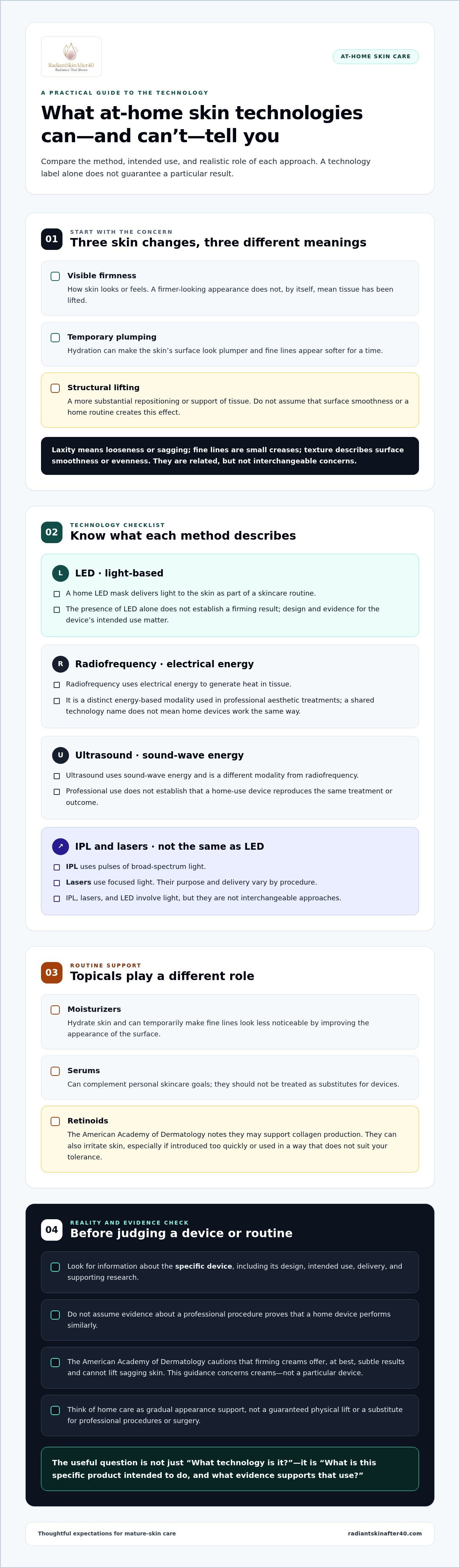
Three effects are easy to confuse. Visible firmness describes how skin looks or feels. Temporary plumping can follow hydration, making fine lines appear softer for a time. Structural lifting means repositioning or supporting tissue in a more substantial way. A smoother, moisturized surface may be welcome, but it is not proof of a lift.
At-home skin tightening is a routine of non-surgical care intended to support a firmer appearance, not a guarantee of lifted skin. Home devices and professional procedures also differ in intended use and energy delivery. Professional treatments may reach deeper tissue or use different settings. Evidence about a professional procedure does not establish that a home device performs similarly, so keep those expectations distinct.
What changes in mature skin can affect firmness?
Collagen helps provide skin with structural support, while elastin contributes to its ability to stretch and return. Changes in these components can influence firmness and resilience, but the pace and visible pattern vary from person to person. Skin history, environment, and individual biology all shape how changes appear.
Laxity, fine lines, and texture are related, but they are not interchangeable concerns. Laxity describes looseness or sagging; fine lines are small creases, and texture concerns the surface’s smoothness or evenness. A routine that improves surface hydration may soften the look of fine lines without meaningfully changing laxity. Naming your main concern clearly helps align expectations with the approach.
What results are realistic from a home routine?
Think in terms of gradual appearance support, not dramatic transformation. A moisturizer or serum can improve hydration and the temporary plumpness of the skin’s surface. A device is a different type of intervention, but its results depend on its design, instructions, and intended use. Neither should be assumed to create the degree of lifting associated with surgery or a professional procedure.
The American Academy of Dermatology cautions that firming creams offer, at best, subtle results and cannot lift sagging skin. That guidance relates to creams; it is not evidence for or against a particular device. It does underline why claims should be matched to the method being discussed rather than generalized across all home approaches.
Set a baseline before beginning: note the areas you want to address and how your skin looks in consistent lighting. Follow the device’s own directions, and observe changes over time rather than judging after one use. Comfort matters too. A routine you can follow without irritation or unnecessary complexity is more useful than a collection of ambitious steps. Look for modest visible shifts, and remember that day-to-day hydration can alter appearance without indicating lasting structural change.
How At-Home Tightening Technologies Aim to Support Skin
“A technology label describes the tool, not the result.” That distinction matters in non invasive skin tightening at home, where devices and skincare products work in different ways. Performance depends on more than the name printed on the box. A professional treatment’s mechanism or clinical evidence cannot automatically be applied to a home-use device. Design, intended use, delivery, and research on the specific device all shape reasonable expectations.
How do LED, radiofrequency, and ultrasound differ?
LED is light-based technology. A home LED mask delivers light to the skin as part of a skincare routine, but its presence alone does not establish a firming result. The device’s design and evidence for its intended use matter.
Radiofrequency and ultrasound are distinct energy-based modalities used in professional aesthetic treatments. Radiofrequency uses electrical energy to generate heat in tissue; ultrasound uses sound-wave energy. IPL and laser procedures also involve light, but they are not interchangeable with LED: IPL uses pulses of broad-spectrum light, while lasers use focused light. Their purpose and delivery vary by procedure.
These descriptions explain broad categories, not a promise that a home-use device reproduces a professional treatment. Devices can use the same technology name while differing in design and intended use. Look for information tied to the specific device rather than assuming that a familiar term guarantees a particular outcome.
Technology names can suggest how a device works, but they cannot predict results without evidence about the device itself.
Where do skincare products fit alongside devices?
Topical care supports a different part of a routine. Moisturizers help hydrate the skin, which can temporarily make fine lines look less noticeable by improving the appearance of the surface. That effect can be useful, but it is not the same as a device-supported change or a structural lift. Serums can also complement personal skincare goals without being treated as device substitutes.
Retinoids are another topical option sometimes used in skincare routines. The American Academy of Dermatology notes that they may support collagen production, but they can also irritate skin, particularly when introduced too quickly or used in a way that does not suit an individual’s tolerance. Follow product directions, introduce active ingredients thoughtfully, and pay attention to dryness, redness, or discomfort.
Keep each step in its proper role. A moisturizer supports hydration; a topical active may target specific skin concerns; an LED mask is a light-based home skincare modality. A composed routine might include LED face and eye masks alongside familiar skincare, while keeping expectations grounded in each option’s intended use. More steps are not automatically better. Choose a manageable combination, follow device instructions, and assess changes over time rather than expecting one technology to do everything.
Which At-Home Skin Tightening Approach Fits Your Goals?
The right starting point depends on what you want to address: skin comfort, a smoother-looking surface, or more pronounced laxity. This comparison separates options by their role and likely scope. It is not a promise of results. A device’s design and evidence matter, and professional treatments should not be treated as equivalent to home care.
| Approach | Intended role | Home-use context | Expectation level |
|---|---|---|---|
| LED mask | A light-based skincare step that may complement a home routine. | Use according to the device’s instructions and intended use. | Consider it supportive care, not a guaranteed tightening or lifting treatment. |
| Topical skincare | Moisturizers support hydration; other products may target specific skincare concerns. | Can fit into regular care, with active ingredients chosen thoughtfully. | Hydration may temporarily soften the look of fine lines. Products shouldn’t be expected to lift sagging skin. |
| Other home devices | Different device types are designed for different purposes and use distinct technologies. | Check the specific device’s directions, intended use, and evidence rather than relying on a category label. | Expectations depend on the individual device; don’t assume results match a professional treatment. |
| Professional modalities | Procedures may be chosen for more noticeable changes, depending on the method. | Not part of a home skincare routine; delivery and intended use differ. | Potential outcomes vary. They are not a measure of what a home device can achieve. |
When might an LED mask be a considered home option?
An LED mask may suit someone who wants to include light-based technology in a considered skincare routine, without treating it as a stand-alone solution for laxity. Before use, read the device’s instructions and intended use, and consider whether it fits comfortably into your existing routine. Masks can differ in design and evidence, so do not assume they all work alike. A separate home skin tightening devices guide can help you explore device categories in more detail.
When are expectations beyond home care?
If your main concern is pronounced laxity, home skincare may not create the degree of change you hope for. The American Academy of Dermatology describes firming creams as offering subtle results at best, while more pronounced tightening involves different options and expectations. That distinction is not a diagnosis or a direction to pursue a procedure. It is a way to choose a home routine with clear eyes: prioritize comfort and overall appearance when those are your goals, and do not mistake moisturized skin for a lift.
For non invasive skin tightening at home, begin with the outcome you value most, then choose an approach whose intended role aligns with it. A thoughtful choice is one you understand, can use as directed, and can assess without expecting every option to deliver the same result.
How to Choose and Use a Home Skin-Firming Routine Thoughtfully
A considered routine starts with a clear question: what change are you hoping to see? With non invasive skin tightening at home, that answer can help you avoid choosing an approach that does not match your concern. Evaluate devices by their intended use and supporting evidence, not by confident claims alone.
Use this four-step framework:
- Define the concern. Identify whether you’re focused on dryness, fine lines, uneven texture, or visible laxity. These concerns can overlap, but they aren’t the same.
- Choose a modality. Match the option to your goal. For example, moisturizer may support skin comfort and hydration, while an LED mask is a light-based skincare tool. Neither should be assumed to provide structural lifting.
- Read the instructions. Review the device’s intended use, directions, fit, and applicable safety information before incorporating it. Follow its guidance rather than borrowing a schedule from another device or inventing one.
- Track changes. Note what you observe and how your skin feels over time. Look for gradual patterns rather than judging the routine after a single use.
What should you assess before choosing a device?
Decide what would count as a meaningful change for you. Is your aim a more comfortable routine, a smoother-looking surface, or a visible difference in laxity? Read the device information with that goal in mind. Check that its stated purpose aligns with what you are seeking, that its directions are clear, and that it fits comfortably into your routine. Treat bold claims as a reason to look for device-specific evidence, not as proof of performance.
How can you build a calm, consistent routine?
Keep the surrounding care simple. Use the device only as directed, and avoid adding several new products or tools at once. Introduce compatible skincare thoughtfully, then pay attention to comfort. If irritation or discomfort appears, pause and review the product or device directions rather than pushing through. A skin texture guide for women over 40 can offer related context for shaping a routine around surface concerns.
For clearer comparisons, take photos under similar conditions: use consistent lighting, a similar angle, and a relaxed facial expression. Hydration, time of day, and expression can change how lines and texture appear, so a single image may not reflect a lasting shift. Keep notes brief and practical. Consistency should make the routine easier to assess, not more demanding.
Thoughtful care is measured, not hurried. Explore LED face and eye masks and skincare tools as options within a simple home routine, keeping their stated purpose and your expectations aligned.
Where LED Face and Eye Masks Fit in At-Home Skin Care
An LED face or eye mask can add a device-based step to a mature-skin routine. It is a home skincare modality, not a substitute for lifting procedures, and its presence in a routine does not guarantee tighter-looking skin. Think of it as one option alongside foundational care, such as gentle cleansing and moisturization, rather than a shortcut that replaces them.
What role can an LED mask play in a mature-skin routine?
The value of a home device depends on its intended use, directions, and fit with your routine. LED face and eye masks are designed for at-home use, but specifications and directions can differ between devices. Read the guidance for the particular mask and follow it as written. Do not assume that a routine or expectation for one device applies to another. Individual experience can also vary, so keep expectations measured.
Consistent foundational skincare still matters. Moisturizer can support skin comfort and hydration, while an LED mask offers a distinct, light-based step. Neither should be treated as a promise of a facelift-like effect. For readers considering the eye area specifically, this at-home LED eye mask guide provides a more focused perspective.
Convenience can be part of the appeal: a home-use device may feel easier to incorporate than a more complex routine. But convenience is useful only if the mask feels comfortable and its instructions are clear. If a step adds stress, discomfort, or confusion, it may not be a good fit for sustained use.
How can readers decide whether this approach feels right?
Start with your goal. If you’re looking for a manageable addition to everyday skincare, an LED mask may be worth considering as one option. If you expect pronounced lifting, a home mask should not be assumed to deliver that kind of change. Separate what you hope to support, such as a cared-for appearance, from outcomes that require a different approach.
Before settling into a routine, consider whether the device’s stated purpose aligns with your goal, whether you can follow its directions, and whether it feels comfortable to use. Keep the rest of your skincare steady as you introduce it, so you can better notice how your skin responds. Avoid rushing toward more frequent use or adding multiple new products in pursuit of faster change. A calm, sustainable rhythm is a more thoughtful foundation than urgency.
LED masks are one possible element of non invasive skin tightening at home, with clear limits: they are home skincare devices, not lifting procedures. If this approach aligns with your expectations, explore LED face and eye masks as a considered addition to your routine.
Choose a Routine That Feels Right
Your next step can be simple: choose a home-care approach that supports the way you want to care for your skin, rather than chasing an idealized result. With non invasive skin tightening at home, a thoughtful routine is one you can understand, use comfortably, and sustain without pressure. Let your priorities guide the pace.
RadiantSkinAfter40 specializes in LED face and eye masks designed for mature skin, alongside skincare tools and topical care for at-home routines. Explore these options as part of a personal ritual, not as a promise of a particular transformation. A considered choice leaves room for individual differences and keeps the focus on care that feels right for you.
Explore LED face and eye masks and find a considered starting point for your routine. Take your time, choose with confidence, and let consistency feel like care.
Frequently Asked Questions
Can at-home skin tightening really firm sagging skin?
At-home devices may support a firmer-looking appearance, but they should not be relied on to lift noticeably sagging skin. Results depend on the specific device and individual response, and home use is not equivalent to a professional procedure or surgery. For non invasive skin tightening at home, set expectations around gradual, potentially subtle changes. If your main concern is pronounced laxity, consider whether a home routine matches the degree of change you hope to see.
Is an LED mask the same as radiofrequency skin tightening?
No. An LED mask uses light, while radiofrequency uses a different form of energy. They are not interchangeable, and the word “tightening” on a device description does not establish that it works like another technology. Read the device’s intended use and directions, and look for evidence relevant to that specific device. Do not assume a home LED mask delivers the same effect as a radiofrequency treatment.
How long does it take to see results from a home skin device?
There is no one reliable timeline for every home device. The device, its directions, the concern you are addressing, and your individual response all matter. Follow the manufacturer’s recommended use and any guidance about when to assess changes. An appearance shift right after applying moisturizer may reflect hydration, not a lasting device effect. Avoid increasing use to speed results, and compare changes under similar conditions.
Can I use a retinoid with an LED face mask?
Possibly, but do not assume every retinoid and device can be combined in the same routine. Retinoids can cause dryness, redness, or sensitivity, so check the instructions for both the product and mask. If either directs you to avoid combining them, follow that guidance. If you’re using a prescription retinoid or have had irritation, ask the prescribing clinician or a qualified health professional how to use the device safely.
Is at-home skin tightening safe for every skin type?
No device can be assumed suitable for every person or skin type. Check its warnings and directions for restrictions related to skin conditions, eye concerns, or medicines that increase light sensitivity. If you have a known photosensitivity condition, take medication that affects light sensitivity, or are unsure whether a warning applies to you, get personalized guidance from a healthcare professional before use. Stop if you notice an unexpected reaction.
What should I do if a home device causes redness or discomfort?
Stop using the device and remove it rather than continuing through discomfort. Follow its instructions for an unwanted reaction, and avoid using it again until your skin has settled. Do not try to counter irritation by adding strong active products. If redness worsens, persists, or comes with pain, swelling, blistering, or eye symptoms, seek prompt medical advice. Make a note of the device and products used before the reaction.