


The most advanced device may be the wrong one for your skin. With advanced beauty technology for home spanning LED masks, microcurrent tools and radiofrequency devices, comparing claims can feel like decoding a manual. For mature skin, the best choice isn’t necessarily the one with the most features. It’s the one that fits your goals, feels comfortable to use and can become part of your routine.
Before choosing, consider what you want the device to do, how its instructions fit your existing skincare and whether you’re likely to use it regularly. At-home devices may offer more gradual, subtle results than professional treatments, so a considered choice matters more than a passing trend.
This guide compares common device categories and practical factors to weigh, including intended use, instructions and routine demands. It also explains how LED face and eye masks can fit into simple home care, with realistic expectations and guidance for using devices thoughtfully.
Key Takeaways
- Compare LED, microcurrent, and radiofrequency by their general use and routine demands, not by trend or feature count alone.
- Assess evidence and claims for the specific device; results and protocols can vary within the same technology category.
- Choose advanced beauty technology for home according to your skincare goals, comfort, and ability to use it consistently.
- Follow the device’s own instructions for preparing skin and using it, rather than relying on generalized schedules or social-media advice.
- Explore how LED face and eye masks may fit a simple, repeatable home-care ritual for mature skin.
What counts as advanced beauty technology for home?
At-home beauty technology includes devices designed for personal use as part of a skincare routine. Common examples include LED masks and other light-based tools, microcurrent devices, and radiofrequency devices. “Advanced” describes the technology involved, not a promise of dramatic results. The name of a category alone can’t tell you what a particular device is designed to do or what to expect from it.
For mature skin, advanced beauty technology for home is most useful when it supports a routine you can follow comfortably. Before settling on a device, identify your priority, check the device’s stated intended use and instructions, and consider whether its format works for you. LED face and eye masks, for example, offer a home-use format that can be incorporated into a simple skincare ritual. An overview of Light-emitting diode (LED) therapy provides background on the technology, while benefits and expectations should be assessed for the specific device.
How home devices differ from professional treatments
Home devices are intended for personal use, generally without a practitioner operating them during each session. Professional procedures take place in a clinical or treatment setting and involve a different level of professional oversight. Their methods, operating parameters and expected outcomes may differ, so a home device shouldn’t be treated as a substitute for medical care or a clinic-based procedure. Results and suitability can vary with the technology, device and individual.
Which skincare goals can technology support?
Start with a specific, realistic goal, such as finding a repeatable skincare step that fits your routine. Depending on the device and its evidence, people may also explore appearance-related aims, but outcomes aren’t guaranteed and shouldn’t be assumed from broad category claims. Choose a technology that aligns with what you hope to support and fits comfortably alongside your existing routine. If a skin concern persists, changes or causes discomfort, seek advice from a qualified clinician rather than relying on a beauty device to address it.
Keep the decision practical: identify your priority, read the device’s intended use and precautions, then ask whether you can follow its instructions consistently. The following sections explain how common technologies work and what to compare before choosing one.
How at-home beauty technologies work: light, microcurrent, and radiofrequency
These device categories use different forms of energy, so their names aren’t interchangeable. Understanding the broad mechanism can help you compare devices, but it can’t establish how effective or suitable a particular model will be. Look at the device’s design, settings, instructions and supporting evidence rather than relying on its category label.
LED light therapy and at-home masks
LED devices use selected light as a home-use treatment. LED stands for light-emitting diode; Light-emitting diode (LED) therapy is also discussed as photobiomodulation. Red and near-infrared are distinct light descriptions. Check the specific device’s stated light types and intended use instead of assuming a mask includes either or delivers a particular effect. An at-home LED eye mask guide offers further context for considering this format.
The term LED alone doesn’t establish that a device will produce a particular change in the skin. Claims about visible effects or clinical outcomes need evidence relevant to the specific device and its use. For a broader overview of cosmetic devices and their regulation, consult the FDA’s information on aesthetic devices.
Microcurrent and radiofrequency devices
Microcurrent devices use low-level electrical current, while radiofrequency devices deliver radiofrequency energy. They are separate technologies, not two names for the same treatment. Designs and protocols vary, so the category alone doesn’t establish a device’s intensity, intended application or likely outcome.
Read the instructions for the specific device, including where and how it’s intended to be used. Don’t assume that a claim made about one model applies to every device in its category. An at-home device also shouldn’t be presumed equivalent to a professional procedure using a different system or protocol.
To narrow your options, compare the stated purpose, application method and routine steps for each device. If LED face and eye masks are the technology you’re exploring, browse LED mask options for home care as one way to focus your research on a repeatable skincare ritual.
How to compare at-home beauty technology without overpromising results
Start with fit, not the feature count. The best advanced beauty technology for home is one that addresses a goal you care about and has instructions, care needs and regular use that feel manageable. A device that stays in its box can’t contribute to your routine, however sophisticated its technology sounds.
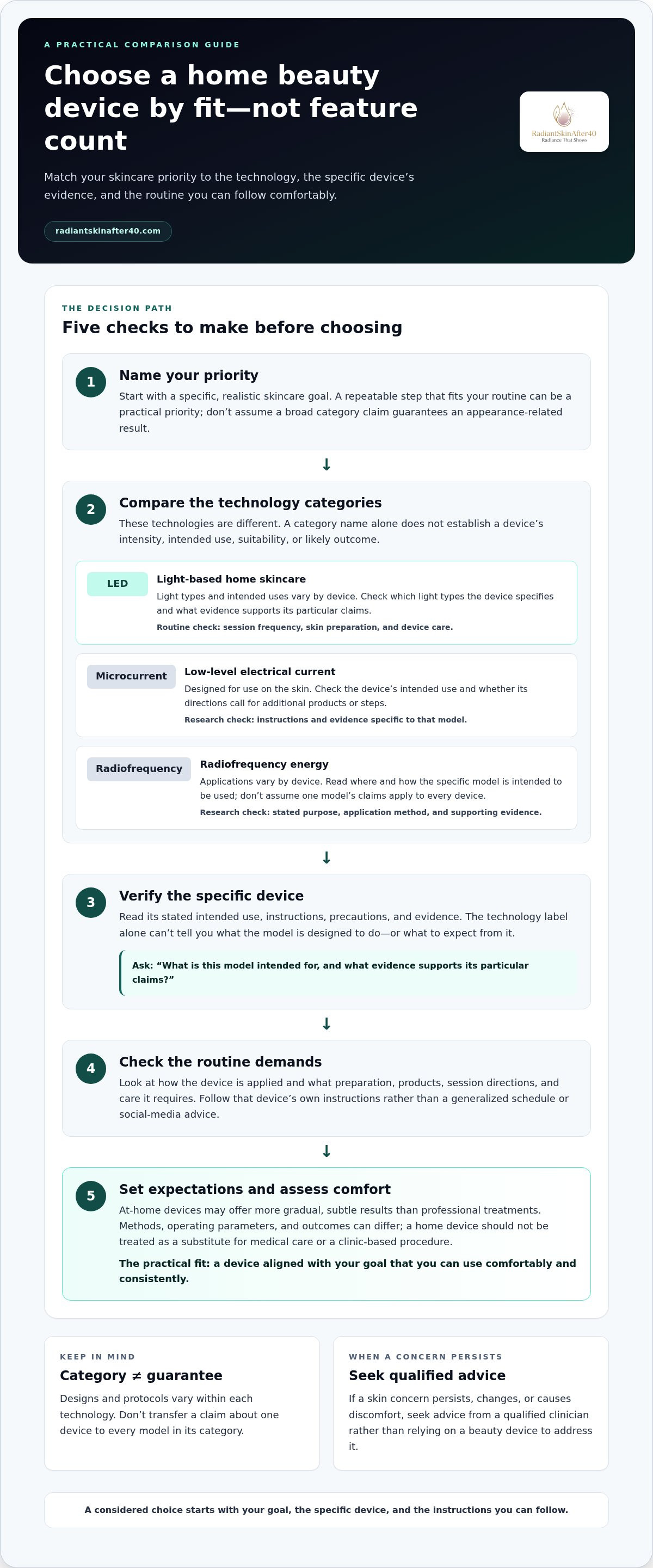
| Technology | General use | Routine demands | Questions to research |
|---|---|---|---|
| LED | Light-based home skincare, with intended uses varying by device | Check the maker’s directions for session frequency, preparation, and care | Which light types does this device specify? What evidence supports its particular claims? |
| Microcurrent | Electrical-current technology designed for use on the skin | Determine how the device is applied and whether its directions call for additional products or steps | What is its intended use? Are the instructions and evidence specific to this model? |
| Radiofrequency | Energy-based technology with device-specific applications | Review application directions, care requirements, and how the device fits your existing routine | What performance claims are made, and what supports them for this device? |
What to assess before choosing a device
Read beyond the headline claims. Compare the stated intended use, application directions, cleaning or storage needs, and any preparation or aftercare steps. Look for support tied to the specific device instead of assuming evidence for one technology applies to every model in that category. For red light, Harvard Health Publishing’s overview of red light therapy offers useful context for considering claims and expectations.
Then picture the device in your actual routine. Consider when you would use it, whether its directions add steps and whether those steps work alongside products you already use. If the process feels complicated or inconvenient, it may be difficult to maintain. A considered choice should complement your skincare, not turn it into a project.
How to set realistic expectations
Visible changes, if they occur, can vary between people and devices. Treat a device as a possible addition to a consistent routine, not a route to an instant or guaranteed transformation. Follow the manufacturer’s directions, observe how your skin responds and reassess whether the device still feels appropriate. Don’t increase use beyond its instructions to chase faster results.
For a focused look at one category, explore this at-home skin-tightening device guide. If LED is a better fit for your routine, you can also browse LED face and eye masks as a home-care option.
Build a safe, consistent at-home beauty technology routine
A device is easier to use consistently when it fits naturally into your skincare routine. Keep the process simple as you introduce advanced beauty technology for home, and let the manufacturer’s instructions guide each step. General schedules and social-media routines can’t account for every device, product or individual.
A simple sequence for adding a device
- Read first. Review the full instructions, including precautions, intended use and care requirements.
- Prepare your skin as directed. Follow the device maker’s guidance rather than assuming it should be used on bare or product-covered skin.
- Use the device as instructed. Follow its stated application method and schedule. Daily use isn’t appropriate for every device.
- Continue your routine. Complete your other skincare steps in the order and manner recommended for the device and products you use.
While you’re learning how a device fits, avoid adding several new tools or products at once. A simpler routine makes it easier to notice comfort, consistency and any change in your skin’s response. If irritation or discomfort occurs, stop using the device. Seek guidance from a qualified clinician when symptoms persist or you’re unsure whether it’s suitable for you.
Using serums alongside LED masks
Serum compatibility depends on the formula, the LED mask’s instructions and your individual skin. Don’t assume a serum should be applied before or after a session, or that a particular ingredient is suitable, unless product-specific directions support it. Keep your established skincare steps steady as you introduce a mask, and follow the guidance for both the device and the serum.
For further reading on pairing skincare with this device category, see the serum guide for LED mask treatments. Use it to frame the questions to consider, then follow the directions for your own products and device.
Consistency should feel sustainable, not demanding. Follow the device’s directions rather than increasing use on your own to pursue faster results, and reassess whether the routine remains comfortable and manageable.
Explore LED face and eye masks for home care to find an option that can complement a thoughtful skincare ritual.
Why LED face and eye masks suit a considered home-care ritual
LED face and eye masks bring light-based skincare into a home setting, in a format that may suit people who value a repeatable ritual. For mature skin, a device can be a considered addition when it fits comfortably into the routine you already keep, rather than requiring a more elaborate regimen. The practical benefit is having a device to use at home according to its specific directions, not a promise of a particular result.
When a face or eye mask may fit your routine
Think about the coverage you’re looking for and where a device could fit in your usual skincare rhythm. A face mask may suit someone whose priority is a face-focused step, while an eye mask may appeal to someone seeking a format centered on the eye area. The right choice depends on the individual device, its intended use and its instructions. Don’t assume that all masks offer the same coverage or are used in the same way.
Convenience matters, but so do realistic expectations. Skin response and visible changes, if any, vary between individuals and devices. An LED mask isn’t a treatment for a medical condition or a replacement for clinical care. Follow the device’s directions and stated precautions, and pause use if you experience irritation or discomfort. For more context on choosing and using this format, read the LED eye mask guide for mature skin.
A home-use mask may suit you if you prefer skincare steps that are easy to repeat and can be incorporated without crowding out the rest of your routine. If a device feels inconvenient, uncomfortable or difficult to use as directed, that’s useful information about its fit. Consistency should feel sustainable, not like another obligation.
A measured next step
Before choosing, return to four questions: What is its purpose? Are its instructions clear? Can you use it consistently as directed? How does your skin respond? These practical checks are more useful than a feature list alone. Give the device time to show whether its place in your routine feels workable, without increasing use beyond its instructions in pursuit of faster change.
LED face and eye masks can sit alongside other skincare categories, including serums, moisturizers and body care, without requiring any particular pairing. Keep the routine personal and simple. To explore the brand’s LED face and eye masks, take a calm next step toward a home-care ritual that fits your priorities.
Choose a Routine That Feels Right
Choosing advanced beauty technology for home doesn’t mean choosing the most complex device. Start with your skincare goal, assess evidence and instructions for the specific device, and consider whether its use fits comfortably into your routine. Results can vary, so consistent use as directed and a realistic view of what a device may offer are more useful than trend-led promises.
For mature skin, LED face and eye masks offer a considered home-care format when their directions and routine demands suit you. RadiantSkinAfter40 specializes in LED masks designed for mature skin, alongside complementary skincare essentials, including serums and moisturizers. These products can support a thoughtful routine without requiring a particular pairing.
Make your next step simple and personal. Explore LED face and eye masks for a more considered home-care ritual, and choose a routine you can approach with confidence.
Frequently Asked Questions
What is advanced beauty technology for home?
Advanced beauty technology for home describes devices designed to support skincare routines outside a clinic or spa. Examples include LED masks and other personal-use skincare tools, though each technology differs in purpose and operation. “Advanced” doesn’t automatically mean clinically proven or suitable for everyone. Before choosing a device, review its intended use, read its directions and look for evidence that supports claims about that specific device.
Which at-home beauty technology is best for mature skin?
There isn’t one best device for every person or skin concern. Start with the outcome you’re seeking, then compare each device’s intended use, instructions, routine demands and supporting evidence. LED face and eye masks are one home-care category designed for mature skin. Choose a format that feels manageable and follow its directions, rather than assuming that every device in a category offers the same benefits.
Are at-home LED face masks safe to use?
Safe use depends on the specific mask, its instructions and your individual circumstances. Read all precautions and use the device only as directed. Stop if you experience discomfort or irritation. If you have a skin condition or eye concern, or you’re unsure about medication-related sensitivity, seek advice from a qualified healthcare professional before use. Don’t assume that another person’s experience means the same device is right for you.
Can at-home beauty devices replace professional treatments?
No. Home devices and professional treatments can differ in setting, oversight, equipment and intended use, so a home device shouldn’t be treated as equivalent to a clinical procedure or as a substitute for medical care. If you’re considering treatment for a persistent or medical skin concern, discuss appropriate options with a qualified clinician. A personal-use device may be one part of a skincare routine, but it has limits.
How often should I use an at-home beauty device?
Follow the instructions for your specific device, since schedules aren’t interchangeable across technologies or products. More frequent use doesn’t necessarily mean better results and may not suit every person. Read the directions and precautions before starting, then pay attention to your skin’s response. If you’re unsure whether use is appropriate for you, or if discomfort develops, pause and seek qualified guidance rather than increasing use on your own.
Can I use serum with an LED face mask?
Compatibility depends on the mask’s instructions, the serum formula and how your skin responds. Some routines may call for using a device on clean, dry skin, while directions vary by product. Don’t assume every active ingredient is suitable before or after a session. Follow both the mask and serum directions, and simplify your routine if irritation develops. If you’re uncertain about compatibility, seek qualified advice.
Do at-home beauty devices produce immediate results?
Don’t assume an at-home device will create an immediate or guaranteed visible change. Outcomes can depend on the technology, the specific device, consistent use and individual skin. Assess claims carefully and use home technology as one possible element of a broader routine, rather than a replacement for foundational skincare. For persistent concerns or questions about suitability, professional guidance from a qualified clinician may help you decide on appropriate next steps.